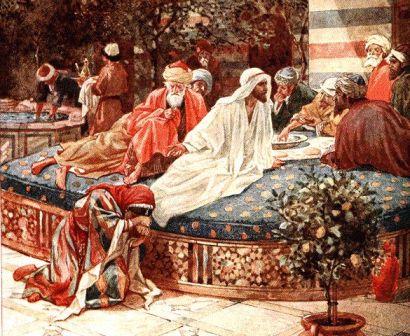
 A Pharisee invited him to dine with him, and he entered the Pharisee’s house and reclined at table.
Now there was a sinful woman in the city who learned that he was at table in the house of the Pharisee. Bringing an alabaster flask of ointment, she stood behind him at his feet weeping and began to bathe his feet with her tears. Then she wiped them with her hair, kissed them, and anointed them with the ointment.
When the Pharisee who had invited him saw this he said to himself, „If this man were a prophet, he would know who and what sort of woman this is who is touching him, that she is a sinner.”
Jesus said to him in reply, „Simon, I have something to say to you.” „Tell me, teacher,” he said.
„Two people were in debt to a certain creditor; one owed five hundred days’ wages and the other owed fifty.
Since they were unable to repay the debt, he forgave it for both. Which of them will love him more?”
Simon said in reply, „The one, I suppose, whose larger debt was forgiven.” He said to him, „You have judged rightly.”
Then he turned to the woman and said to Simon, „Do you see this woman? When I entered your house, you did not give me water for my feet, but she has bathed them with her tears and wiped them with her hair.
You did not give me a kiss, but she has not ceased kissing my feet since the time I entered.
You did not anoint my head with oil, but she anointed my feet with ointment.
So I tell you, her many sins have been forgiven; hence, she has shown great love. But the one to whom little is forgiven, loves little.”
He said to her, „Your sins are forgiven.”
The others at table said to themselves, „Who is this who even forgives sins?”
But he said to the woman, „Your faith has saved you; go in peace.”
(Gospel of Luke 7,36-50)
Unul dintre farisei l-a invitat să mănânce la el. A intrat în casa fariseului şi s-a aşezat la masă. Şi iată, era în cetate o femeie păcătoasă. Aflând că el era în casa fariseului, a adus un vas din alabastru plin cu miresme. Plângând, stătea în spate, la picioarele lui. A început să-i ude picioarele cu lacrimi, le ştergea cu părul capului ei, îi săruta picioarele şi le ungea cu miresme.
Văzând aceasta, fariseul care îl chemase îşi spunea în sine: „Dacă acesta ar fi fost profet, ar fi ştiut cine şi ce fel de femeie este aceasta care îl atinge, căci este o păcătoasă”. Răspunzând, Isus i-a zis: „Simon, am să-ţi spun ceva”. Iar el a zis: „Spune, Învăţătorule!” „Un creditor avea doi debitori. Unul îi datora cinci sute de dinari, iar celălalt cincizeci. Deoarece nu-i puteau restitui, i-a iertat pe amândoi.
Deci, care dintre ei îl va iubi mai mult?”
Simon i-a răspuns: „Cred că cel căruia i s-a iertat mai mult”. El i-a zis: „Ai judecat corect”.
Atunci, întorcându-se către femeie, i-a spus lui Simon: „Vezi femeia aceasta? Am intrat în casa ta şi tu nu mi-ai turnat apă pe picioare; ea, însă, mi-a udat picioarele cu lacrimi şi mi le-a şters cu părul ei. Sărut nu mi-ai dat; ea, însă, de când a intrat, nu a încetat să-mi sărute picioarele. Tu nu mi-ai uns capul cu untdelemn, ea însă mi-a uns picioarele cu miresme.
De aceea îţi spun: i s-au iertat păcatele ei cele multe, pentru că a iubit mult; însă cui i se iartă puţin, iubeşte puţin”. Apoi a spus către ea: „Păcatele ţi-au fost iertate”.
Cei care erau cu el la masă au început să spună: „Cine este acesta care iartă şi păcatele?”
Însă el a zis femeii: „Credinţa ta te-a mântuit; mergi în pace!”
(Evanghelia după sfântul Luca 7,36-50)
 Prea târziu te-am iubit...
Lasă un comentariu